An element is a pure substance that cannot be decomposed into simpler substances by normal chemical means. There are 109 different elements. Ninety of these are naturally occurring; the rest have been created in laboratories. Elements 110 and 118 are still being researched on. There will be more elements as technology can identify them. A symbol is used to represent the full name of an element. For example, H represents hydrogen; O represents oxygen, and Al represents aluminum. Sometimes the Latin name for an element is used as the basis for its symbol, for instance K represents potassium (kalium in Latin).
Three subatomic particles compose elements: protons, neutrons, and electrons. Protons, which have an electrical charge of +1, and neutrons, which have a neutral charge, make up the nucleus of an element. This nucleus is surrounded by a "cloud" of electrons, each of which as a charge of -1. The electrons spin around the nucleus in what are called orbits or shells. Each of the orbits can contain a set number of electrons. For instance, the first orbital from the nucleus has 2 electrons, the second has 8, the third has 8, the 4th has 16 and the fifth has 32, and so on. Each shell may not be full, depending on the number of electrons in the element, and the inner shells fill before the outer shells fill. Sodium, for example, has 11 electrons, which are located in the first, second, and third shells (2+8+1.)
An element has a uniform composition. Different elements may join together; these combinations are called compounds. A compound can be separated into its component elements by chemical means. For example, common table salt is a compound made of two elements: sodium and chlorine. Table salt can be broken down into sodium and chlorine by mixing it with water. However, sodium and chlorine cannot be easily broken down into any simpler forms.
PROCEDURE:
-
Discuss the properties of elements with the students. Review the structure of the periodic table. Ask students questions about the different elements and see if they can locate them on the periodic table.
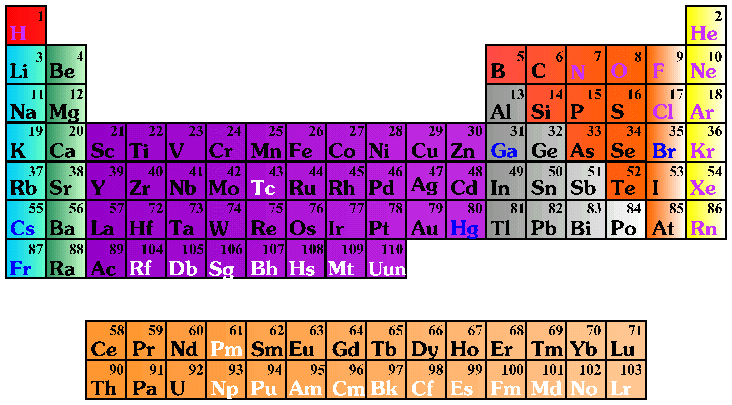
- Use the Periodic Table placemats to explore elements with the students. When they examine the chart, the students may ask the meaning of the numbers surrounding the element symbols. The number in the upper left corner is the atomic number, i.e., the number of protons inside the nucleus of the element. The number in the lower left is the atomic mass or atomic weight, which is essentially a measurement of how heavy the element is.
Explain the basic subatomic structure of elements. Tell the students that protons and neutrons reside inside the nucleus. The electrons spin around the nucleus in what are called orbits or shells. Each of the orbits represents a set number of electrons. For instance, the first orbit from the nucleus has 2 electrons, the second has 8, the third has 8, the 4th has 16 and the fifth has 32, and so on. Sodium for instance, has 11 electrons located in the first, second, and third shells (2+8+1.)

Explain the characteristics of chlorine..
BalasHapusUnder standard conditions chlorine is a gas that forms a diatomic molecule. This means that two chlorine atoms join together to form Cl2. Chlorine gas is greenish yellow, has a very strong odor (it smells like bleach), and is poisonous to humans. High concentrations of chlorine gas can be fatal.
HapusChlorine is highly reactive and as a result, not found in free form in nature, but only in the form of compounds with other elements. Chlorine will dissolve in water, but will also react with water dissolved. Chlorine will react with all other elements except the noble gases.
Most common chlorine compounds are called chlorides, but also form compounds with oxygen called chlorine oxide.
explain the characteristic of brom
BalasHapusAt room temperature bromine (bromine) in the form of brownish brown liquid.
HapusIn the form of gas, the brom is the same color (brownish red) with an offensive odor and stifling like a chlorine smell.
Bromine is the only non-metallic element that is liquid at room temperature and volatile at standard temperature and pressure.
Bromine is less active than chlorine and fluorine but is more active than iodine. Bromine dissolves in organic solvents and water.
Bromine is a natural element that can be found in many inorganic materials.
However, humans incorporate organic brom into the environment through various activities.
Bromine due to human activity that does not occur naturally has the potential to cause serious damage to human health and the environment.
In the crust of the earth, natural bromine forms as a bromide salt. The bromine salt accumulates in seawater (85 ppm), from which bromine is usually extracted.
The world production of bromine is estimated to exceed 300,000 tons per year, with three major producing countries namely the United States, Britain, and Britain.
What elements are included in the thyroid hormone?
BalasHapusThyroid hormone (English: thyroid hormone, TH) is a classification of hormones that refers to the derivatives of amino acid tyrosine compounds synthesized by the thyroid gland by using iodine. There are two types of hormones from this classification of tetra-iodotironina and tri-iodotironina. Both types of these hormones have a very vital role in the body's metabolism.
HapusThe term thyroid hormone is also often used to refer to the intake of organic compounds in hormonal therapy such as levotikroksin, or associated isoforms; Although against the other two thyroid hormones CT and PTH
Thyroid hormone is the main driver of metabolism and growth with deiodination of tetra-iodotironine that triggers respiration in the complex I of the mitochondrial respiratory chain, which is one of the factors of basal metabolic rate; And modulation of genetic transcription through tri-iodotironine absorbers present in the cell nucleus. The importance of the role of TH began to be recognized in the 19th century when a case of thyroid gland enlargement with a symptom of hyperthyroidism resulted in heart failure, exophthalmos and accelerated basal metabolic rate. Further studies are then conducted, providing knowledge that both thyroid hormone T4 and its more reactive molecule, T3 has a pleiotropic effect. Conversion of T4 to T3, in blood plasma is called monodiodination, occurs by many ID-I enzymes found in the liver and kidney, and ID-2 found in the brain, pituitary and adipose tissue chocolate. Both types of deiodinase enzymes contain Selenium compounds, with glucocorticoids as promoter compounds.
The genetic expression of the myosin isoforms such as Na + ATPase, K + ATPase, and Ca2 + ATPase present in the sarcoplasmic reticulum, also controlled by TH
Lack of TH concentrations, as demonstrated by hypothyroidism, is a result of the inhibition of oxidative pathways such as the oxidation reaction of pyruvic acid, whereas excessive TH concentration will accelerate the pathway of glycolysis as suspected in hyperthyroidism. Excessive TH concentrations or deficiencies can cause hypotonia from the buildup of lactic acid called lacticacidemia.
TH also has a hypocholesterolemic property that lowers the cholesterol plasma ratio without accelerating the trajectory of cholesterol catabolism to bile acids, as well as increasing the ratio of kenodeoxycholic acid.
T4 half-life is about 5-9 days while for T3 is only about 1 day.
This hormone is also known to play a role in the complement immune system in increasing the rate of MBL trajectory, increased complement proteins C3, C4 and CH50, and increased blood plasma proteins such as:
Transferrin, prothrombin, angiotensinogen, haptoglobin, alpha and beta chains of alpha-2-HS-glycoprotein, lipoprotein and fibrinogen
And decreased levels of similar proteins, among others:
Clusters, macroglobulins-α2 precursors, α-protimosin and α-fetoproteins.